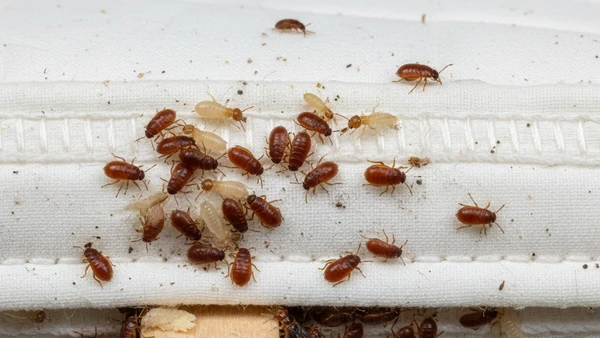
An ant trail in the kitchen is annoying. Most people reach for a spray, kill the ones they can see, and assume that's handled it.
Whether that's enough — and whether you should be more concerned than annoyed — depends almost entirely on which ant you're dealing with. Black ants and red ants behave differently, cause different problems, and in one case, the bite is genuinely something to take seriously.
Here's the actual difference between them.
Black ants — what they are and what they want
The black ant most commonly found inside Indian homes is the common black garden ant — Lasius niger — or one of the several small black ant species.
They're after sugar and carbohydrates mostly. A drop of spilled juice, crumbs near the toaster.
Do they bite? Technically yes, but it's almost meaningless in practice. The bite of a common black ant is so minor that most people don't notice it. No venom, no sting, no swelling. If you sit on a colony and hundreds of them are crawling on you, you'll feel something. A few in the kitchen — nothing.
The real problem with black ants isn't pain. It's contamination. They walk across drains, bin areas, floor surfaces, and then across your food preparation counter or directly into an uncovered food container. They carry bacteria on their bodies. A trail of black ants moving through your food is a hygiene issue, not a medical one — but it's still a real issue.
Red ants — a meaningfully different situation
This is where the conversation changes.
The red ants that cause problems in Indian homes are typically fire ants (Solenopsis species) or red weaver ants (Oecophylla smaragdina — locally called lal bainsi in many parts of India). Both bite. Both are significantly more aggressive than common black ants. And both have a response to disturbance that's worth understanding before you step on a colony barefoot.
Fire ants are the more concerning of the two for indoor situations. They bite with their mandibles to anchor themselves, then sting repeatedly with the abdomen — delivering venom with each sting. The result is an immediate sharp burning sensation, followed by a raised white pustule that appears at the sting site within hours. In healthy adults, this is painful but manageable. In people with venom allergies, fire ant stings can trigger anaphylaxis — a medical emergency.
Fire ants are not passive. If you disturb a nest — even accidentally, by moving something sitting on top of it — the colony mobilises fast. They don't sting one at a time. A disturbed fire ant colony sends hundreds of workers onto whatever disturbed it within seconds. This is the scenario that causes serious bites — not a single wandering ant, but a suddenly provoked colony at scale.
They're particularly dangerous around young children who play on the ground, elderly people who may not respond quickly to the sensation, and anyone who doesn't notice they've stepped on or near a nest before the colony has already started climbing their foot.
Red weaver ants are large, reddish-orange, and live in tree canopy nests built from leaves. They're more commonly an outdoor and garden problem but enter homes when a tree branch touches a wall or roof. Their bite is sharp — they grip hard with mandibles and some species also spray formic acid into the wound. Painful, but typically not dangerous unless you have a sensitivity.
Where each one nests — and why it matters
Black ants nest underground, in wall voids, in the soil of potted plants, under paving stones, or in small gaps in construction. The nest is usually outside or inside a wall — the trail you see in the kitchen is a foraging line, not where they actually live.
This is important because spraying the trail with a contact insecticide kills the ants you can see and leaves the colony completely intact. New foragers emerge within hours following the same pheromone trail. The trail you sprayed is populated again the next day.
Fire ants build mound nests — dome-shaped soil structures, usually in open ground, garden beds, near compound walls, or under paving stones. Indoors, they nest in wall voids, under floors, and occasionally inside electrical junction boxes — the warmth attracts them. A fire ant colony in a junction box is a specific hazard because any contact with the nest triggers the defensive response described above.
Which is more dangerous — the direct answer
For most adults, black ants are a nuisance and a hygiene concern. Not a danger.
Red ants — specifically fire ants — are a genuine physical hazard, particularly for children, elderly people, and anyone with a venom allergy. The sting is painful regardless, and the colony response to disturbance is what makes them dangerous rather than just uncomfortable.
If you have young children in the house and you've found a fire ant mound in the garden or compound, treat it as a priority. Not something to deal with eventually. The scenario of a child sitting or playing near an undiscovered nest and being stung dozens of times before adults notice is exactly how serious fire ant incidents happen in India.
What to do about each one
For black ants, the most effective approach is gel bait — the same type used for cockroach control, but formulated for ants. The foraging ants pick it up and carry it back to the nest, where it spreads through the colony. This gets to the source rather than just the trail. Don't spray contact insecticide near a bait placement — it will deter foragers from picking up the bait, which defeats the purpose.
Also find and seal their entry point. A trail always comes from somewhere. Follow it to the wall, the window frame, the gap in the baseboard — wherever they're entering. Seal that with sealant after the bait has reduced the colony.
For fire ants, a mound treatment is needed. Boiling water poured directly into the mound entrance kills ants near the surface but rarely reaches the queen deep in the structure. Commercial fire ant bait works on the same slow-spread principle as black ant gel — workers carry it to the queen. For large or multiple mounds, a professional treatment is the more reliable option because it reaches the whole colony structure rather than just the accessible surface.
Don't disturb a fire ant mound manually without protection. Knocking it with a stick or your foot to "see if they're active" triggers exactly the defensive response you want to avoid.