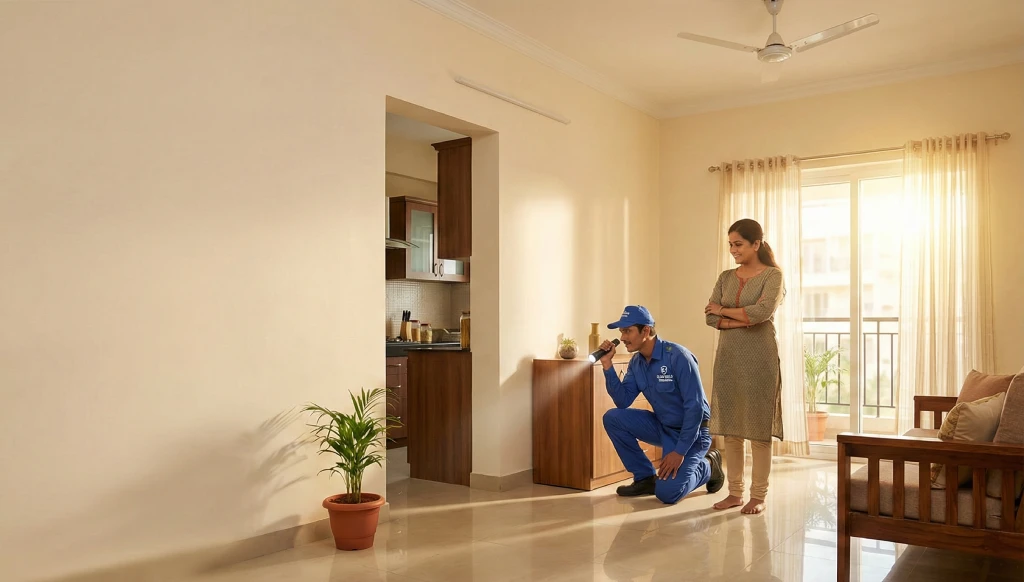
Pest control services in Vapi for homes, GIDC worker colonies, industrial-edge residences & offices. Termites, cockroaches, bed bugs, rodents & mosquitoes. Free inspection, fixed pricing, warranty. Call PestEnd.
Fill form to get a call back in 10 mins
Customized solutions for Vapi's climate and pest problems.
""Worker colony flat near the GIDC road — cockroaches despite spraying every 3 months. PestEnd gel treatment and sealed the drainage pipe entry at the back wall. Gone next morning and still clear 4 months later. They explained the industrial re-supply issue which finally made sense of why nothing was lasting.""
""Old Vapi town house — termites in the main door frame and the kitchen wall base. Previous treatment wore off within one monsoon season. PestEnd did the full perimeter and explained the Damanganga moisture issue. Eight months clear. That's the longest it's held.""
""New society flat, 4 years old — mosquitoes from the low-lying plot behind the building through October. PestEnd treated the standing water patches and fogged. Clear difference by day 3, held through the rest of monsoon season. Good, honest work.""
Vapi GIDC is one of India's largest and densest industrial estates. Chemicals, pharmaceuticals, dyes, plastics, textiles — hundreds of manufacturing units packed into a compact industrial zone on South Gujarat's coast.
Everyone knows what the GIDC produces. Nobody talks about what living next to it does to the pest situation in Vapi's residential areas.
Industrial food waste from worker canteens operating at scale. Organic effluent from processing that seeps into soil and drainage channels across the GIDC perimeter. Warm machinery environments that stay active through winter when residential areas cool. Rodent populations established near grain, sugar, and organic raw material storage at the industrial estate don't follow urban rat patterns — they're denser, they have consistent food supply, and they cycle outward into GIDC-adjacent worker colonies year-round.
That's the first thing Vapi has that no other Gujarat city on this list has.
The second is the Damanganga river. Vapi sits on the Damanganga's lower reaches before it meets the Arabian Sea near Daman. Tidal influence pushes salt-humid air inland through the river corridor. Properties along the Damanganga belt — the older Vapi town residential areas nearest the river, the Chala road stretch, the Daman border zone — sit on soil that combines South Gujarat's heavy rainfall saturation with tidal moisture influence. Termites in these areas have no meaningful dry season.
Third: Daman. The union territory is 10km away. Cross-border migrant worker movement between Vapi's GIDC and Daman's manufacturing zones means high-turnover residential properties on both approach roads. Chawl accommodation, dense worker housing, mattress-sharing in single rooms. Bed bug reintroduction in this corridor is among the most consistent of any area in South Gujarat.
Pest control ↗ in Vapi that ignores the GIDC perimeter, the Damanganga tidal belt, and the Daman border corridor is treating a generic city. Vapi is not a generic city.
GIDC perimeter residential colonies — worker housing along GIDC Road, Phase 1, Phase 2 and Phase 3 edges — the closest residential fabric to the industrial estate. Cockroach and rodent pressure here is driven by external industrial food sources that don't switch off. Treating a flat on this belt requires gel bait that works against re-supply pressure — and thorough sealing of pipe and drainage entries that connect the flat to the industrial-edge drainage network. One-time spray without sealing gives 2–3 weeks here, not 3 months.
Old Vapi town and Koparli Road residential belt — pre-industrial Vapi, older construction, original drainage infrastructure. Dense residential fabric, shared boundary drainage, properties built close together in the original town layout. Termites in old Vapi properties on Damanganga-adjacent low ground have the combined pressure of South Gujarat's heavy rainfall and tidal moisture — among the most sustained termite soil moisture conditions in the region.
Chala and Daman border residential corridor — the stretch between Vapi and Daman has migrant worker density that creates specific bed bug cycling. High turnover rooms, shared mattresses, transit accommodation used by workers commuting between the two industrial zones. Bed bugs establish here and spread faster than in standard residential areas because the mattress-replacement cycle is slow relative to the turnover rate.
Bhinar and the expanding eastern residential belt — new societies, newer construction, Vapi's growth direction away from the GIDC. Alluvial South Gujarat soil, fresh excavation, 3–7 year old flats. Pre-possession termite treatment is rarely standard here. Year 2 and 3 is when door frames begin to show activity in this area.
Kolak river and Damanganga low-lying stretches — where the two river systems create low-lying pockets in the residential fabric. Post-monsoon standing water here persists longer than in elevated inland areas. Mosquito breeding in these pockets runs through October and into November in the years with a late monsoon recession.
Commercial kitchens and food establishments near Vapi railway station and the main market — restaurant galleys, dhaba kitchens, market storage units adjacent to residential above-shop flats. Shared drainage stack cockroach pressure in the market belt follows the old-city pattern of every dense commercial zone in Gujarat.
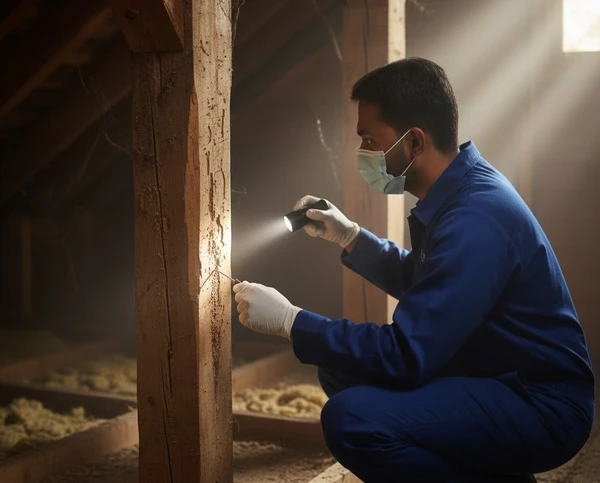
Termites Old Vapi town property near Damanganga belt, new Bhinar society flat, GIDC-adjacent colony quarter — treatment matches the structure. For Damanganga riverside and old Vapi town construction, the tidal moisture influence means South Gujarat's already-elevated soil moisture baseline is even higher here — treatment must cover the complete foundation perimeter at correct injection depth. Partial perimeter work degrades in Vapi's moisture conditions before the next monsoon. For new Bhinar construction under 3 years old, pre-flooring soil treatment is still accessible — significantly cheaper than full post-possession drilling.
Cockroaches GIDC-adjacent worker colony kitchens, Koparli Road residential flats, commercial kitchens near Vapi Station — odorless gel bait in exact harbourage points: pipe chases, behind modular panels, wall-floor joints. No prep. No smell. No vacating. Active next morning. For GIDC-perimeter properties with industrial-edge re-supply pressure, we combine gel treatment with thorough drainage-entry sealing — that's what makes results hold beyond 3–4 weeks on this belt.
Mosquitoes Damanganga and Kolak low-lying stretches, post-monsoon standing water in Chala Road low pockets, open plots in Bhinar new societies — Vapi's heavy South Gujarat rainfall and two river corridors extend breeding season into November. Larvicide in every standing source before fogging. Fogging without larvicide gives one week of results and then the low-lying sources reset the population. Both steps together holds.
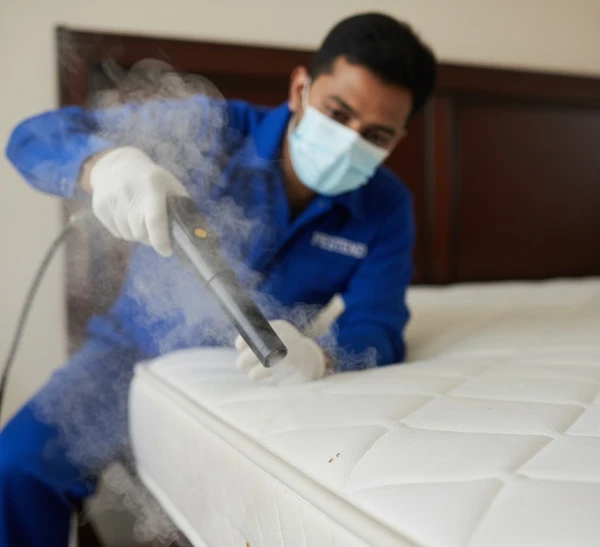
Bed Bugs Chala–Daman border worker corridor accommodation, transit rooms near Vapi railway station, PG housing near the GIDC Phase 1 worker belt — high-turnover reintroduction. Heat treatment combined with targeted chemical application clears adults and eggs. Standard spray moves bed bugs. It doesn't finish them. In worker accommodation with high turnover, a mattress inspection protocol after each treatment is worth discussing — we can advise.
Rodents GIDC-edge ground-floor residential units, old Vapi town compound walls with original drainage gaps, Damanganga riverside properties with kuccha boundary drainage — industrial-edge rodent pressure needs sealing, not just baiting. We locate every real entry point, seal with material they cannot gnaw through. Without sealing, the GIDC-sourced pressure refills the space within one season. Every time.
General Pest Control Ants, silverfish, spiders, wood borer, lizards — one visit covers all. April pre-monsoon timing is important here — South Gujarat's monsoon arrives earlier and harder than north Gujarat, so pre-treatment before May is the right call.
|
Service |
1 BHK |
2 BHK |
3 BHK |
|
₹999 |
₹1,299 |
₹1,599 |
|
|
Termite Treatment |
₹3,500 |
₹5,500 |
₹7,000 |
|
Bed Bug Treatment |
₹1,499 |
₹2,599 |
₹3,499 |
|
Mosquito Control |
₹999 |
₹1,899 |
₹2,599 |
|
General Pest Control |
₹899 |
₹1,299 |
₹1,599 |
|
Rodent Control |
₹1,500 |
₹2,500 |
₹3,000 |
GIDC commercial units, large worker colony complexes, industrial-adjacent food businesses, and riverside heritage properties quoted separately after inspection. Price confirmed before treatment — nothing added on the day.
Looking for pest control services in Vapi near me? We serve:
Vapi town · GIDC Phase 1 · GIDC Phase 2 · GIDC Phase 3 · Koparli Road · Chala · Daman Road corridor · Bhinar · Vapi Railway Station area · Samarvarni · Udwada Road · Kolak riverside belt · Damanganga riverside · Dungri · Sanjan Road · Vapi main market · Atul township · Bhilad · Nargol Road and surrounding localities.
Not listed? Call — confirmed in minutes.
Free inspection first. Within 24 hours. GIDC-edge colony or new Bhinar flat — inspection depth suits the property. We assess infestation level, entry points, moisture sources, industrial-edge pressure, what is actually driving the problem. Free. No commitment.
Fixed price after inspection. Confirmed before treatment starts. Nothing changes on the day.
Treatment. We bring all equipment. Standard flats done in 1–2 hours. Exact re-entry timing per room before we leave.
Follow-up at 7–10 days. Activity in the warranty window? We return. No charge.
Book your free inspection — no pressure, just find out what's actually there and what it costs to fix.