Let's settle this immediately.
White ants and termites are the same insect. "White ant" is just a nickname — and a pretty misleading one. Termites are not ants. They're not even distantly related to ants. Biologically speaking, they're closer to cockroaches than anything else.
But the confusion matters, and not just as a trivia point. Because people who think they're dealing with "white ants" often underestimate the problem, delay treatment, or apply the wrong fix entirely. And termites — whatever you call them — cause damage that insurance in India almost never covers.
Why we call them white ants in the first place
Walk around any neighbourhood in Rajasthan or anywhere in India and you'll hear the term constantly. It came from the obvious — the pale, almost translucent body of the worker termite does look vaguely ant-like, and they live in large colonies with a social structure that superficially resembles an ant colony.
But the nickname stuck harder than it should have. And the problem is that treating a termite problem like an ant problem — or buying ant control products to deal with them — does essentially nothing.
What actually makes a termite different from an ant
If you ever find yourself looking at one under decent light, here's what to check:
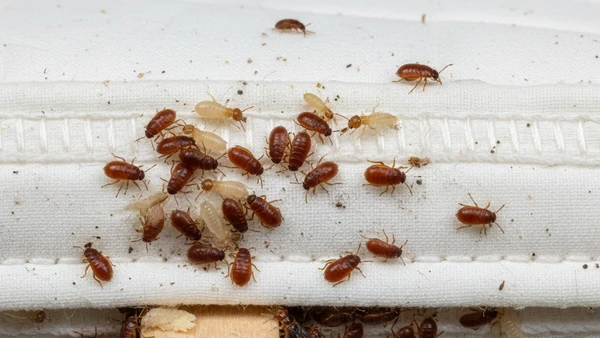
The body shape is the biggest giveaway. Ants have that classic pinched waist — narrow in the middle, like an hourglass. Termites don't. Their body goes straight from head to abdomen, no narrowing. Thick and pale the whole way through.
The antennae are different too. Ant antennae bend at an angle, like a bent elbow. Termite antennae are straight and beaded — like a string of tiny round beads.
If you're looking at winged ones (which people see during swarming season), the wings give it away instantly. A flying ant has front wings that are noticeably bigger than the back ones. A flying termite has four wings of equal length — often longer than the body itself — and they shed them after mating, which is why you sometimes find little piles of wings near window sills after a swarm.
The pale colour comes from the fact that worker termites almost never come above ground. They have no need to deal with sunlight, so over time they evolved without pigmentation. What you're seeing is essentially a creature built entirely for the dark.
The part that actually damages your house
People focus too much on identifying what they've seen and not enough on understanding what's already happened inside the walls.
Termites — subterranean ones especially, which are the most common type in Indian homes — feed from the inside out. They'll eat through the centre of a wooden beam and leave just a thin outer shell intact. Tap on it and it sounds hollow. That's usually how people first realise something is wrong — except by then, the damage has been going on for months, sometimes years.
The real ants versus termites confusion
There's a version of this that actually matters practically. Some people see genuine ants — black, brown, or red ones — and mistake them for termites. Or vice versa.
Regular ants in your house, while annoying, cause minimal structural damage. Carpenter ants tunnel through wood to nest but they don't eat it. Still worth dealing with, but a completely different urgency level.
Termites eating through your furniture, floor joists, or roof beams — that's a different category of problem entirely. The Indian subcontinent has around 26 pest termite species, and the damage they cause to wooden structures is genuinely significant. It builds silently over time with no visible exterior sign until something collapses or warps badly enough to notice.
What treatment actually looks like
This is where the ant-termite confusion causes the most real-world harm. People buy over-the-counter ant sprays and apply them. It doesn't work. Not because the products are bad, but because they're designed for the wrong insect with completely different behaviour.
Anti-termite treatment in India typically involves two approaches. For an active infestation, a chemical soil barrier — termiticide injected into the ground around the foundation — cuts off the colony's access to the structure. For ongoing protection in older homes or homes in high-risk areas, baiting systems are installed which the termites carry back to the colony, gradually eliminating it from the source.
Neither of these is something you do yourself. The injection points need to be placed correctly to form a complete barrier. A gap in coverage is a gap the termites will find.
The other thing worth knowing: most insurers in India exclude termite damage from standard home policies. The entire cost of structural repair — and it can be substantial — falls on the owner. Which is why getting a professional check done before buying a property, or at least once every couple of years in high-risk areas, makes practical sense beyond just peace of mind.
So what do you actually have?
If you've spotted pale, soft-bodied insects near wood, in the soil, or following mud tubes along your walls — those are termites. Call them white ants if you want, but treat them like the structurally destructive insects they are.
If they're darker, have that pinched waist, and you've seen them marching in a trail toward food — those are actual ants. Still worth dealing with. Different fix.
And if you're not sure — that's also a legitimate answer. A professional inspection takes a couple of hours and tells you definitively what you have and how far it's spread.
Pestend provides termite control and anti-termite treatment across Rajasthan. Visit pestend.in to book a free inspection.