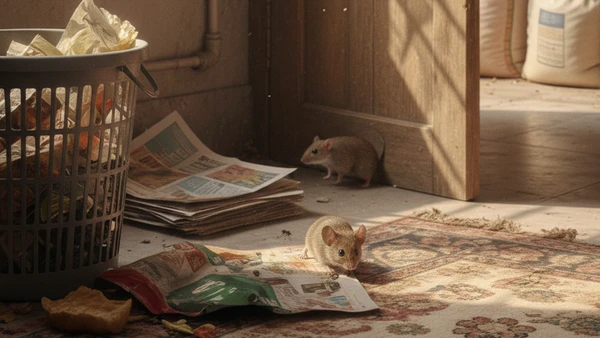
A warehouse manager in Jaipur once told me his team had been setting snap traps along the walls for three months. They were catching rats regularly — two or three a week. And the problem wasn't getting better.
That's the thing about rodent control in large commercial spaces. The methods that work well enough in a home kitchen fall apart completely when you scale up to a 5,000 square foot godown with multiple entry points, stacked inventory, and a rat population that's been established for months or years.
The approach has to be different. Here's what it actually involves.
Why godowns are so hard to control
A home has maybe three or four places rats could be nesting. A warehouse has dozens — behind racking, inside pallets, under loading bays, in wall cavities, in suspended ceiling spaces, in the gaps where electrical conduits pass through walls.
Food storage warehouses in India often have grain, pulses, packaged goods, or raw materials sitting in large quantities. That's a food source that never runs out. Combined with stacked inventory that provides perfect nesting cover and very little human disturbance at night — you've created ideal conditions.
The bandicoot rat (Bandicota bengalensis) is the species most commonly found in Indian godowns and is particularly difficult to deal with. It's larger than the common house rat, more aggressive, more resistant to some anticoagulant baits, and an extraordinary burrower. A colony of bandicoots in an established godown isn't a minor pest issue — it's a structural and hygiene emergency.
Signs that the situation is serious: gnaw marks on packaging and electrical cables, dark greasy smear marks along wall bases and racking legs where rats travel repeatedly, droppings scattered through multiple areas of the warehouse, and any evidence of burrowing near the foundation or under the floor slab.
One sign people often miss — a persistent, faintly ammonia-like smell in a section of the godown, even after cleaning. That's rat urine. It builds up in nesting areas and along travel routes. It doesn't smell like much in small amounts, but in an established infestation it becomes noticeable.
What professional rodent control for a godown actually involves
It's not one treatment. That's the first thing to understand.
A professional service starts with a full inspection — not a quick walk-around, but a methodical check of every entry point, every area of activity, every potential nesting zone. In a warehouse this takes time. The technician is looking at the perimeter foundation, every gap where pipes or cables enter the building, the condition of loading bay doors and dock seals, the interior wall bases, the racking layout, and any areas with unexplained damage.
From that inspection comes a site-specific plan. A competent pest control ↗ company doesn't show up with the same solution every time — the layout, the stored commodity type, the species present, and the severity of the infestation all change what's appropriate.
The methods used in commercial settings
Tamper-resistant bait stations are the backbone of commercial rodent management. Unlike open bait placement — which is dangerous in food storage environments — locked bait stations allow rodenticide to be placed safely in a format that rodents access but humans and pets cannot. Stations are positioned along the perimeter wall at regular intervals (typically every five to ten metres depending on activity level), near entry points, and in identified high-activity zones inside the facility.
The bait used in professional settings is typically a second-generation anticoagulant — brodifacoum or bromadiolone being the most common in India. These are more potent than first-generation products and are effective against bait-shy populations that have learned to avoid simpler baits. Stations are checked and refreshed on a schedule — typically fortnightly for active infestations, monthly for maintenance.
Snap traps and multi-catch traps are used alongside bait stations in areas where poisoned bait isn't appropriate — near machinery, near food processing areas, or where contamination risk is high. They provide the additional advantage of giving you a body count. You know what's been caught, where, and roughly when. That data helps map the infestation and adjust the control programme.
Tracking stations are something few godown managers have heard of. A flat tray with a tracking medium — either chalk dust or a flour paste — placed along suspected travel routes tells you whether rats are active in an area and in which direction they're moving. No control function on its own, but essential for mapping movement patterns in a large facility where you can't observe everything directly.
Electronic monitoring is increasingly available from professional services in larger Indian cities. Sensors placed inside bait stations or traps detect activity and send alerts remotely. Particularly useful for large godowns where checking every station manually every day isn't practical.
Entry point sealing — the part that gets skipped in warehouses
Most commercial rodent programmes treat the infestation. Fewer address why it started.
Loading bay doors are the biggest gap in most Indian godowns. The dock seals around loading bay openings degrade over time — they crack, compress, and develop gaps that a rat walks straight through. Rollers and strip curtains at bay openings help, but only if they're maintained. A strip curtain with three missing strips in the middle is essentially an open door at ground level.
Gaps where electrical conduit enters the building, gaps around water pipes, broken ventilation grilles, gaps under corrugated roofing at the junction with the wall — these are all standard entry points that a proper exclusion inspection identifies and addresses.
Blocking these with the right materials matters. Foam sealant alone isn't sufficient — rats chew through it. Cement mortar for larger gaps, steel wool combined with sealant for pipe penetrations, galvanised metal mesh for ventilation openings and floor drains — these are the materials that actually hold.
FSSAI and regulatory compliance
For food storage and food processing godowns in India, rodent control isn't just an operational preference — it's a regulatory requirement under FSSAI licensing conditions. An active rodent infestation in a licensed food storage facility is a compliance failure.
FSSAI-compliant rodent control requires documented pest management records — inspection reports, bait station logs, treatment records, and technician visit documentation. A professional pest management company operating at commercial level will provide this documentation. A technician from a local service with no formal system probably won't.
If your godown handles food products and you're audited — by FSSAI inspectors, by a retail chain's supplier compliance team, or by an export certification body — having documented pest management records is what separates a compliant facility from one that loses its approval.
How often treatments need to happen
For an active infestation, the early phase of a professional programme typically involves fortnightly visits for the first two to three months. The population is being knocked down but hasn't been eliminated, entry points may not be fully sealed yet, and bait needs to be refreshed frequently.
Once the infestation is under control and exclusion work is complete, a monthly maintenance visit is standard for food-related storage facilities. Quarterly for lower-risk warehouses without food commodities.
The maintenance visit isn't just a formality. It catches new activity early — a fresh burrow near the foundation, a station that's been disturbed, gnaw marks on a previously clean area — before it develops into something requiring intensive treatment again.
The honest cost of doing nothing
A single rat can contaminate far more food than it actually eats. It urinates constantly while moving — on packaging, on surfaces, on the stored product itself. Leptospirosis, salmonella, and other pathogens are spread this way.
Electrical cable damage from gnawing is a fire risk that's underreported in Indian warehouses. The cable develops a fault point, heats up, and the fire risk grows quietly until something triggers it.
And then there's the stock write-off. Damaged packaging, contaminated commodity, goods that can't be dispatched because of evidence of rodent activity. In a busy godown in Rajasthan handling grain, textiles, or FMCG products, a moderately established rat infestation causes financial damage every single week it continues.
Professional rodent management at commercial scale isn't cheap. But compared to any of the above, it's one of the more straightforward value decisions a facility manager makes.