Finding a pest control company in India is easy. There are dozens in every city, hundreds in larger ones, and most of them look identical from the outside — a company name, a phone number, a price that's either suspiciously low or reassuringly high.
Choosing the right one is harder. Because the difference between a professional service that solves your problem durably and a cheap treatment that lasts three weeks and leaves the underlying infestation intact isn't visible from the listing. It shows up only after the treatment, when you're either done with the problem or calling someone else.
Here's how to evaluate before you commit.
The licence question — non-negotiable
Pest control companies operating commercially in India are required to be licensed under the Insecticides Act, 1968. The technicians applying pesticides are required to hold a certificate of competency for handling insecticides.
This isn't bureaucratic detail. An unlicensed operator using unregistered products — which does happen in the informal market, particularly at very low price points — is applying chemicals in your home without oversight over product safety, concentration, or application method. You have no recourse if something goes wrong.
Ask, before agreeing to any service: are you licensed under the Insecticides Act? Which products do you use, and are they registered with the Central Insecticides Board? Can you provide the names of the active ingredients and their SDS sheets?
A legitimate company answers these questions without hesitation. A company that becomes evasive, changes the subject to price, or gives you brand names without active ingredient information — that's the answer.
What the inspection tells you about the company
A pest control company that quotes you over the phone, based on the size of your home and the type of pest you describe, without inspecting the property — is quoting based on assumptions rather than your actual situation.
This matters because cockroach infestations in a 2BHK vary enormously in severity, spread, and harborage location depending on the specific home, its plumbing layout, its construction type, and its history. A quote that doesn't account for these factors is likely based on a standard treatment that may or may not match what your situation requires.
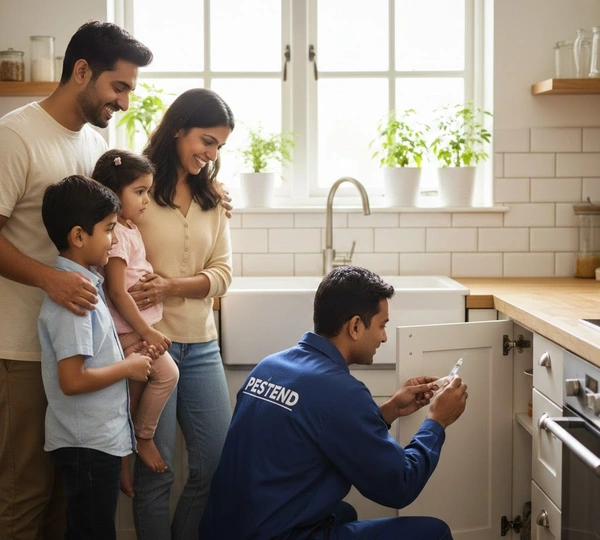
A company that sends a technician to inspect before quoting — to look at harborage areas, identify entry points, assess the spread — is doing the job properly. The inspection also tells you something about the quality of the technician. Are they looking in the right places? Do they check inside equipment, under appliances, behind electrical switch plates? Or is it a five-minute walk-through before moving to paperwork?
The inspection quality predicts the treatment quality. A thorough inspector is usually a thorough technician.
The follow-up and warranty question
A single treatment for any established infestation — cockroaches especially — is rarely sufficient on its own. Eggs hatch, re-infestation from outside continues, and harborage areas that weren't fully reached on the first visit need a second pass.
A company that provides a service warranty — typically 30 to 90 days depending on the pest and treatment type — and includes a follow-up visit if pest activity continues within that window, is providing a more complete service than one that walks away after a single treatment with no callback policy.
Ask specifically: what happens if I still see cockroaches two weeks after the treatment? A good company has a clear answer — usually a follow-up visit within the warranty period at no additional cost, with an assessment of why the activity persists. A company that tells you this means the treatment is working and you should wait longer — without any commitment to come back and check — is protecting itself, not you.
Reading reviews — what to look for and what to ignore
Online reviews for pest control companies in Indian cities are mixed in reliability. Some are genuine, some are incentivised, and the star rating alone tells you very little.
What's worth looking for in reviews: specific mentions of follow-up, mentions of whether the problem actually resolved over time rather than just immediately after treatment, and critically — negative reviews and how the company responded to them.
A company with 4.2 stars and detailed, specific reviews describing the process, the technician's behaviour, and outcomes over weeks is more useful than a company with 4.8 stars from reviews that all sound like "great service, very professional, highly recommend" without specifics. The specificity of a review is a better signal than the rating.
Negative reviews — and every company has them — tell you what went wrong. The response to them tells you what the company does when something goes wrong. A company that dismisses complaints or doesn't respond is showing you how they'll handle your complaint if you have one.
Price comparison — how to do it without just picking the cheapest
The cheapest price in the market almost always involves one or more of: unregistered chemicals at incorrect concentrations, no follow-up, no warranty, an unlicensed technician, or a surface-only treatment that misses harborage areas. Sometimes more than one of these.
The most expensive option isn't automatically the best — premium pricing from a large national brand doesn't guarantee the local franchise technician is any more skilled than a mid-range local provider.
Compare quotes by asking for the same specifics from each company: what active ingredient is being used, how many visit points will be treated, is a follow-up visit included, what's the warranty period. A higher-priced company that includes two visits, a 60-day warranty, and licensed products is a better comparison to a lower-priced company that includes one visit with no warranty than if you compared on price alone.
Get at least three quotes for any non-trivial job. Not to find the lowest, but to calibrate what's reasonable and to use the differences in what's offered as information about each company's approach.
Specific questions worth asking before booking
What active ingredient will you be using for this treatment, and what's the concentration? — This establishes whether the company is using a registered product and whether the technician knows what they're working with.
How many application points will you be treating? — For a cockroach gel treatment, for instance, a thorough job involves dozens of placement points in harborage areas throughout the kitchen, bathroom, and electrical points. Five placement points in a 2BHK is inadequate. If the technician can't describe their placement approach, that's information.
Do you treat entry points as part of the service? — A treatment that doesn't address how pests are getting in is managing the symptom. A company that includes entry point assessment and at least recommends sealing is providing a more complete service.
What should I do before the treatment? — A professional company gives you specific preparation instructions — which items to remove from cabinets, how long to vacate, whether to cover fish tanks, what to avoid doing to treated surfaces afterward. Vague or absent preparation instructions suggest the treatment isn't going to be thorough enough to require specific preparation.
Do you have insurance? — For a commercial or larger-scale job especially, the company should carry liability insurance. For residential, this matters less but is still worth knowing.
The first treatment as a test
You don't have to commit to an annual contract on the first visit. A single treatment gives you enough information to assess whether this is the right company for ongoing work.
Was the technician on time? Did they inspect before applying? Did they explain what they were doing and why? Did they treat the places you'd expect a thorough job to cover — inside equipment, in harborage areas, at entry points — not just visible surfaces?
Did the problem actually resolve, and for how long? Four weeks of no activity followed by gradual return is a normal pattern that a follow-up treatment would address. Zero improvement two weeks after treatment means something significant was missed.
The first job tells you more than any review or recommendation. Use it.
Pestend provides licensed, professional pest control across Rajasthan — with full product disclosure, inspection before treatment, and follow-up within the warranty period. Visit Pestend to book or ask any questions before committing.